Wherever You Go, There You Are… Or, Are You?
Wherever You Go, There You Are… Or, Are You?
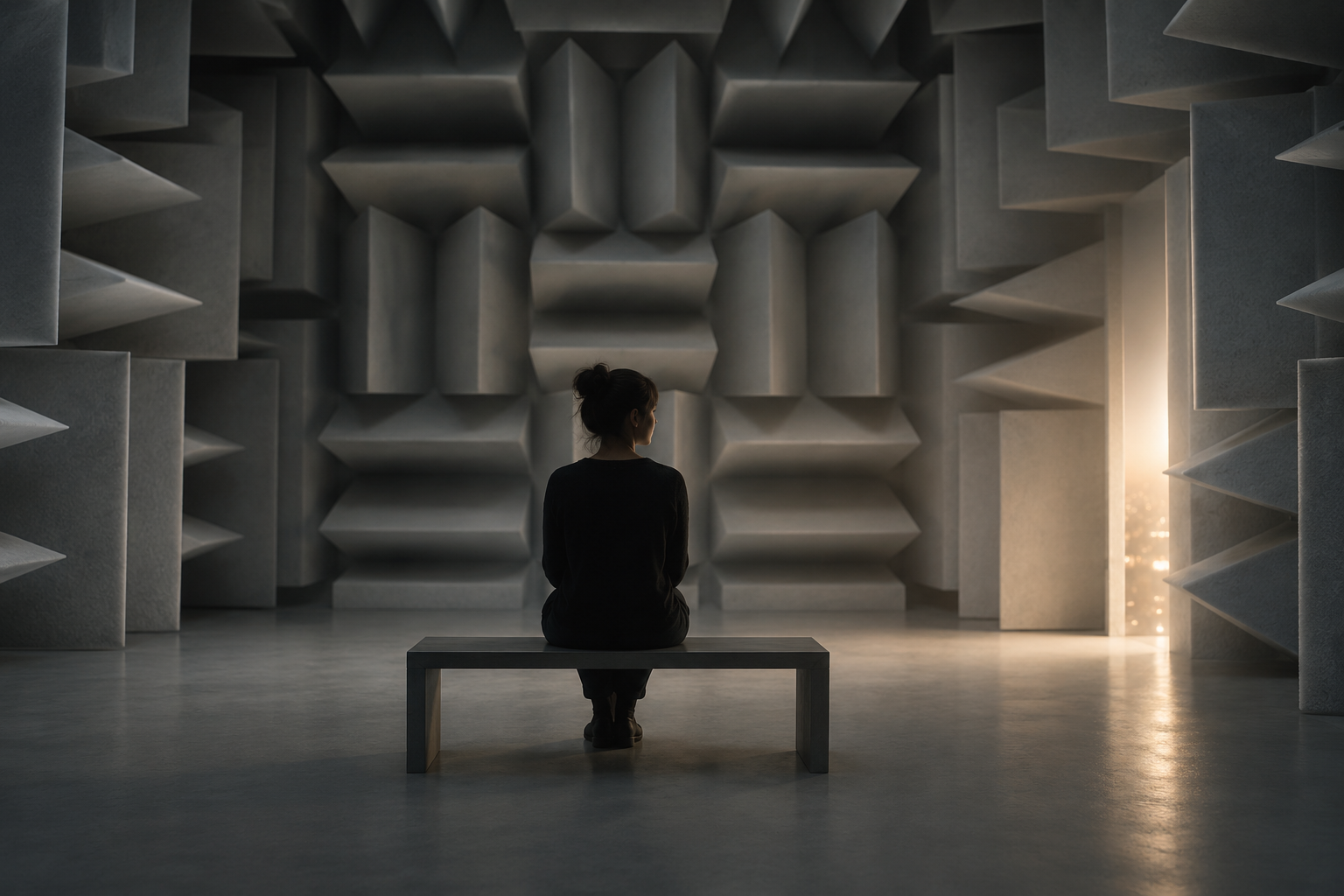
In 1951, composer John Cage walked into an anechoic chamber at Harvard University—a room designed to absorb nearly all sound. He expected absolute silence.
He didn’t get it.
Cage’s iconic composition 4′33″ was shaped in part by this experience. Inside the chamber, he could still hear two sounds. Cage later recalled that the engineer told him one was his nervous system and the other was his blood circulating. He came away believing that silence was not really the absence of sound.
By having a performer sit at an instrument and play nothing, 4′33″ turns our attention to the sounds already in the room. Silence isn’t the absence of sound. It is a different way of listening.
Maybe this is how we can understand presence. We spend a lot of time in places without ever truly settling into them. We are physically there, but our attention is often somewhere else.
Interruptible
Our attention has always been valuable. Newspapers built audiences and sold advertisers access to them; radio and television followed the same model. We received something we wanted, and in exchange, someone else got a little of our attention.
What has changed is that the exchange no longer has a natural stopping point. A newspaper ends. A television gets turned off. But the supercomputer in our pocket can take us somewhere else almost anytime we want to go.
I think we have normalized being interruptible. Even when nothing is actively demanding our focus, part of us is ready to leave.
Forty years ago, opening a newspaper at the dinner table was a pretty clear signal that you had left the conversation. Today, we glance at a phone, put it face down, and resume talking as if we never went anywhere.
But we did leave. And whatever we looked at often comes back with us. Part of our attention is still on what we just saw.
That lingering attention is the part of presence I find most interesting. I don't mean forcing yourself to appreciate every passing second or trying to make an ordinary afternoon feel profound. That sounds exhausting. I simply mean giving our attention enough time to actually land somewhere.
I think this matters most when we are alone. We have become experts at filling empty space. Yet a quiet moment offers a choice: it may give us nothing, or it may give something unfinished the time it needs to become apparent.
Cage walked into a silent room expecting nothing and found sounds that had been there the whole time. I wonder how often we miss what is right around us simply because there is always somewhere else to look.
Wherever You Go…
The title of this piece comes from Jon Kabat-Zinn’s "Wherever You Go, There You Are". I have always loved the directness of that phrase.
I’m just not sure it is quite that simple anymore.
We can occupy a room while part of our attention stays available to somewhere else. We can put the phone away and still spend the afternoon waiting for whatever comes next. Sometimes, our bodies arrive long before our attention does.
In meditation, my mind wanders. Eventually, I notice the drift and bring it back. Then, again, it wanders. The point is not to practice perfection, but practice the return.
Presence in the rest of our lives may work much the same way. We are going to drift and get distracted. The world will always ask for our attention. But occasionally, we can choose to make ourselves unavailable to everywhere else.
I like that thought much more than the exhausting idea to “live in the moment.” It actually feels real.
John Cage went looking for silence and found what was already there.
What might you notice if you stayed exactly where you are a little longer?
If you want to explore these ideas further, read our full Q review of Wherever You Go, There You Are →