“
A novel that does not uncover a hitherto unknown segment of existence is immoral. Knowledge is the novel's only morality.
— Milan Kundera

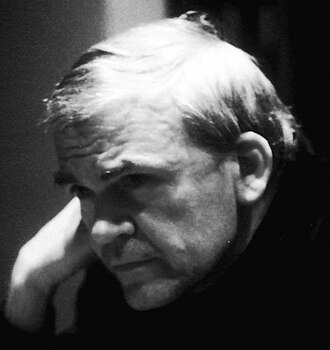
writer, screenwriter, translator, novelist, university teacher, poet, dramaturge, essayist, prose writer, short story writer
🔗 Read on Wikipedia1929 – 2023
A novel that does not uncover a hitherto unknown segment of existence is immoral. Knowledge is the novel's only morality.
How goodness heightens beauty!
What does it mean to live in truth? Putting it negatively is easy enough: it means not lying, not hiding, and not dissimulating.
The characters in my novels are my own unrealised possibilities. That is why I am equally fond of them all and equally horrified by them. Each one has crossed a border that I myself have circumvented.
You can understand nothing about art, particularly modern art, if you do not understand that imagination is a value in itself.
A person's destiny often ends before his death.
Without realizing it, the individual composes his life according to the laws of beauty even in times of greatest distress.
The novelist teaches the reader to comprehend the world as a question. There is wisdom and tolerance in that attitude. In a world built on sacrosanct certainties the novel is dead.
No great movement designed to change the world can bear to be laughed at or belittled. Mockery is a rust that corrodes all it touches.
For Sabina, living in truth, lying neither to ourselves nor to others, was possible only away from the public: the moment someone keeps an eye on what we do, we involuntarily make allowances for that eye, and nothing we do is truthful. Having a public, keeping a public in mind, means living in lies.
He took over anger to intimidate subordinates, and in time anger took over him.
Mysticism and exaggeration go together. A mystic must not fear ridicule if he is to push all the way to the limits of humility or the limits of delight.
Dogs do not have many advantages over people, but one of them is extremely important: euthanasia is not forbidden by law in their case; animals have the right to a merciful death.
Yes, it's a well-known fact about you: you're like death, you take everything.
Yes, it was too late, and Sabina knew she would leave Paris, move on, and on again, because were she to die here they would cover her up with a stone, and in the mind of a woman for whom no place is home the thought of an end to all flight is unbearable.
And therein lies the whole of man's plight. Human time does not turn in a circle; it runs ahead in a straight line. That is why man cannot be happy: happiness is the longing for repetition.
I know, brother, that you are a straightforward man, and that you pride yourself on it. But put one question to yourself:
Mankind's true moral test, its fundamental test (which lies deeply buried from view), consists of its attitude towards those who are at its mercy: animals. And in this respect mankind has suffered a fundamental debacle, a debacle so fundamental that all others stem from it.
Dogs are our link to paradise. They don't know evil or jealousy or discontent.
When graves are covered with stones, the dead can no longer get out. But the dead can’t go out anyway! What difference does it make whether they’re covered with soil or stones?
When someone is young, he is not capable of conceiving of time as a circle, but thinks of it as a road leading forward to ever-new horizons; he does not yet sense that his life contains just a single theme; he will come to realise it only when his life begins to enact its first variations.
Happiness is the longing for repetition.
When graves are covered with stones, the dead can no longer get out. But the dead can’t go out anyway! What difference does it make whether they’re covered with soil or stones?
The degree of slowness is directionally proportional to the intensity of memory. The degree of speed is directionally proportional to the intensity of forgetting.
What could I say? Maybe this: the man hunched over his motorcycle can focus only on the present instant of his flight; he is caught in a fragment of time cut off from both the past and the future; he is wrenched from the continuity of time; he is outside time; in other words, he is in a state of ecstasy; in that state he is unaware of his age, his wife, his children, his worries, and so he has no fear, because the source of fear is in the future, and a person freed of the future has nothing to fear.
You can understand nothing about art, particularly modern art, if you do not understand that imagination is a value in itself.
There is nothing heavier than compassion. Not even one's own pain weighs so heavy as the pain one feels for someone, for someone, pain intensified by the imagination and prolonged by a hundred echos.