“
Intelligence is what you use when you don't know what to do: when neither innateness nor learning has prepared you for the particular situation.
— Jean Piaget

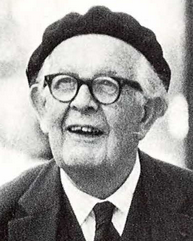
psychologist, zoologist, logician, philosopher, university teacher, malacologist, biologist, pedagogue
🔗 Read on Wikipedia1896 – 1980
Intelligence is what you use when you don't know what to do: when neither innateness nor learning has prepared you for the particular situation.
To express the same idea in still another way, I think that human knowledge is essentially active.
This means that no single logic is strong enough to support the total construction of human knowledge.
It is with children that we have the best chance of studying the development of logical knowledge, mathematical knowledge, physical knowledge, and so forth.
Our problem, from the point of view of psychology and from the point of view of genetic epistemology, is to explain how the transition is made from a lower level of knowledge to a level that is judged to be higher.
In other words, knowledge of the external world begins with an immediate utilisation of things, whereas knowledge of self is stopped by this purely practical and utilitarian contact.
If a baby really has no awareness of himself and is totally thing-directed and at the same time all his states of mind are projected onto things, our second paradox makes sense: on the one hand, thought in babies can be viewed as pure accommodation or exploratory movements, but on the other this very same thought is only one, long, completely autistic waking dream.
Every acquisition of accommodation becomes material for assimilation, but assimilation always resists new accommodations.
Knowing reality means constructing systems of transformations that correspond, more or less adequately, to reality. They are more or less isomorphic to transformations of reality. The transformational structures of which knowledge consists are not copies of the transformations in reality; they are simply possible isomorphic models among which experience can enable us to choose. Knowledge, then, is a system of transformations that become progressively adequate.
I am convinced that there is no sort of boundary between the living and the mental or between the biological and the psychological. From the moment an organism takes account of a previous experience and adapts to a new situation, that very much resembles psychology.
As you know, Bergson pointed out that there is no such thing as disorder but rather two sorts of order, geometric and living. Mine is clearly living. The folders I need are within reach, in the order of frequency with which I use them. True, it gets tricky to locate a folder in the lower levels. But if you have to find it, you look for it. That takes less time than putting them away every day.
Education, for most people, means trying to lead the child to resemble the typical adult of his society... But for me, education means making creators... You have to make inventors, innovators, not conformists.
The principal goal of education in the schools should be creating men and women who are capable of doing new things, not simply repeating what other generations have done; men and women who are creative, inventive and discoverers, who can be critical and verify, and not accept, everything they are offered.
The essential functions of the mind consist in understanding and in inventing, in other words, in building up structures by structuring reality.
Before games are played in common, no rules in the proper sense can come into existence. Regularities and ritualized schemas are already there, but these rites, being the work of the individual, cannot call forth that submission to something superior to the self which characterizes the appearance of any rule.
As far as the game of marbles is concerned, there is therefore no contradiction between the egocentric practice of games and the mystical respect entertained for rules. This respect is the mark of a mentality fashioned, not by free cooperation between equals, but by adult constraint.
The goal of education is not to increase the amount of knowledge but to create the possibilities for a child to invent and discover, to create men who are capable of doing new things.
In certain circumstances where he experiments in new types of conduct by cooperating with his equals, the child is already an adult. There is an adult in every child and a child in every adult. … There exist in the child certain attitudes and beliefs which intellectual development will more and more tend to eliminate: there are others which will acquire more and more importance. The later are not derived from the former but are partly antagonistic to them.
Mixture of assimilation to earlier schemas and adaptation to the actual conditions of the situation is what defines motor intelligence. But — and this is where rules come into existence — as soon as a balance is established between adaptation and assimilation, the course of conduct adopted becomes crystallized and ritualized. New schemas are even established which the child looks for and retains with care, as though they were obligatory or charged with efficacy.
There is little mysticism without an element of transcendence, and conversely, there is no transcendence without a certain degree of egocentrism. It may be that the genesis of these experiences is to be sought in the unique situation of the very young child in relation to adults. The theory of the filial origin of the religious sense seems to us singularly convincing in this connection.
If mutual respect does derive from unilateral respect, it does so by opposition.
The discussion of the game of marbles seems to have led us into rather deep waters. But in the eyes of children the history of the game of marbles has quite as much importance as the history of religion or of forms of government. It Is a history, moreover, that is magnificently spontaneous; and it was therefore perhaps not entirely useless to seek to throw light on the child's judgment of moral value by a preliminary study of the social behaviour of children amongst themselves.
In real life the child is in the presence, not of isolated acts, but of personalities that attract or repel him as a global whole. He grasps people's intentions by direct intuition and cannot therefore abstract from them. He allows, more or less justly, for aggravating and attenuating circumstances. This is why the stories told by the children themselves often give rise to different evaluations from those suggested by the experimenter's stories.
The need to speak the truth and even to seek it for oneself is only conceivable in so far as the individual thinks and acts as one of a society, and not of any society (for it is just the constraining relations between superior and inferior that often drive the latter to prevarication) but of a society founded on reciprocity and mutual respect, and therefore on cooperation.
The child is a realist in every domain of thought, and it is therefore natural that in the moral sphere he should lay more stress on the external, tangible element than on the hidden motive.
The relations between parents and children are certainly not only those of constraint. There is spontaneous mutual affection, which from the first prompts the child to acts of generosity and even of self-sacrifice, to very touching demonstrations which are in no way prescribed. And here no doubt is the starting point for that morality of good which we shall see developing alongside of the morality of right or duty, and which in some persons completely replaces it.
I have always detested any departure from reality, an attitude which I relate to my mother's poor mental health.
It is with children that we have the best chance of studying the development of logical knowledge, mathematical knowledge, physical knowledge, and so forth.
The goal of education is not to increase the amount of knowledge but to create the possibilities for a child to invent and discover, to create men who are capable of doing new things.
The principle goal of education in the schools should be creating men and women who are capable of doing new things, not simply repeating what other generations have done.
I have always detested any departure from reality, an attitude which I relate to my mother's poor mental health.
Scientific knowledge is in perpetual evolution; it finds itself changed from one day to the next.
The current state of knowledge is a moment in history, changing just as rapidly as the state of knowledge in the past has ever changed and, in many instances, more rapidly.
Intelligence is what you use when you don't know what to do: when neither innateness nor learning has prepared you for the particular situation.
It is with children that we have the best chance of studying the development of logical knowledge, mathematical knowledge, physical knowledge, and so forth.