“
The circle of the return to birth can only remain open, but this is a chance, a sign of life, and a wound.
— Jacques Derrida

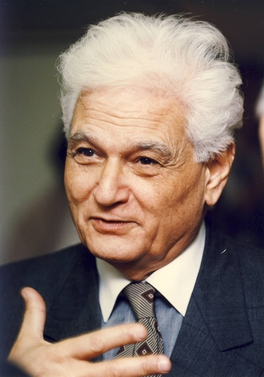
philosopher, literary critic, university teacher, writer
🔗 Read on Wikipedia1930 – 2004
The circle of the return to birth can only remain open, but this is a chance, a sign of life, and a wound.
The end of man (as a factual anthropological limit) is announced to thought from the vantage of the end of man (as a determined opening or the infinity of a telos). Man is that which is in relation to his end, in the fundamentally equivocal sense of the word. Since always.
What is called "objectivity," scientific for instance (in which I firmly believe, in a given situation) imposes itself only within a context which is extremely vast, old, firmly established, or rooted in a network of conventions … and yet which still remains a context.
As soon as we cease to believe in such an engineer and in a discourse which breaks with the received historical discourse, and as soon as we admit that every finite discourse is bound by a certain bricolage and that the engineer and the scientist are also species of bricoleurs, then the very idea of bricolage is menaced and the difference in which it took on its meaning breaks down.
Monsters cannot be announced. One cannot say: 'here are our monsters', without immediately turning the monsters into pets.
Circumcision, that’s all I’ve ever talked about.
I am one of those marranes who no longer say they are Jews even in the secret of their own hearts.
No one gets angry at a mathematician or a physicist whom he or she doesn't understand at all, or at someone who speaks a foreign language, but rather at someone who tampers with your own language, with this 'relation,' precisely, which is yours.
Deconstruction never had meaning or interest, at least in my eyes, than as a radicalization, that is to say, also within the tradition of a certain Marxism, in a certain spirit of Marxism.
Amy Kofman: Have you read all the books in here?Derrida: No, only four of them. But I read those very, very carefully.
Oh. Marx's love for Shakespeare! It is well known. Chris Hani shared the same passion. I have just learned this and I like the idea. Even though Marx more often quotes Timon of Athens, the Manifesto seems to evoke or convoke, right from the start, the first coming of the silent ghost, the apparition of the spirit that does not answer, on those ramparts of Elsinore which is then the old Europe.
No text in the tradition seems as lucid concerning the way in which the political is becoming worldwide. concerning the irreducibility of the technical and the media in the current of the most thinking thought-and this goes beyond the railroad and the newspapers of the time whose powers were analyzed in such an incomparable way in the Manifesto. And few texts have shed so much light on law. international law. and nationalism.
How can one be late to the end of history? A question for today. It is serious because it obliges one to reflect again, as we have been doing since Hegel, on what happens and deserves the name of event, after history; it obliges one to wonder if the end of history is but the end of a certain concept of history.
Confined within this catch-all concept, within this vast encampment of the animal, in this general singular, within the strict enclosure of this definite article (“the Animal” and not “animals”), as in a virgin forest, a zoo, a hunting or fishing ground, a paddock or an abattoir, a space of domestication, are all the living things that man does not recognize as his fellows, his neighbors, or his brothers.
What cannot be said above all must not be silenced but written.
The poet…is the man of metaphor: while the philosopher is interested only in the truth of meaning, beyond even signs and names, and the sophist manipulates empty signs…the poet plays on the multiplicity of signifieds.